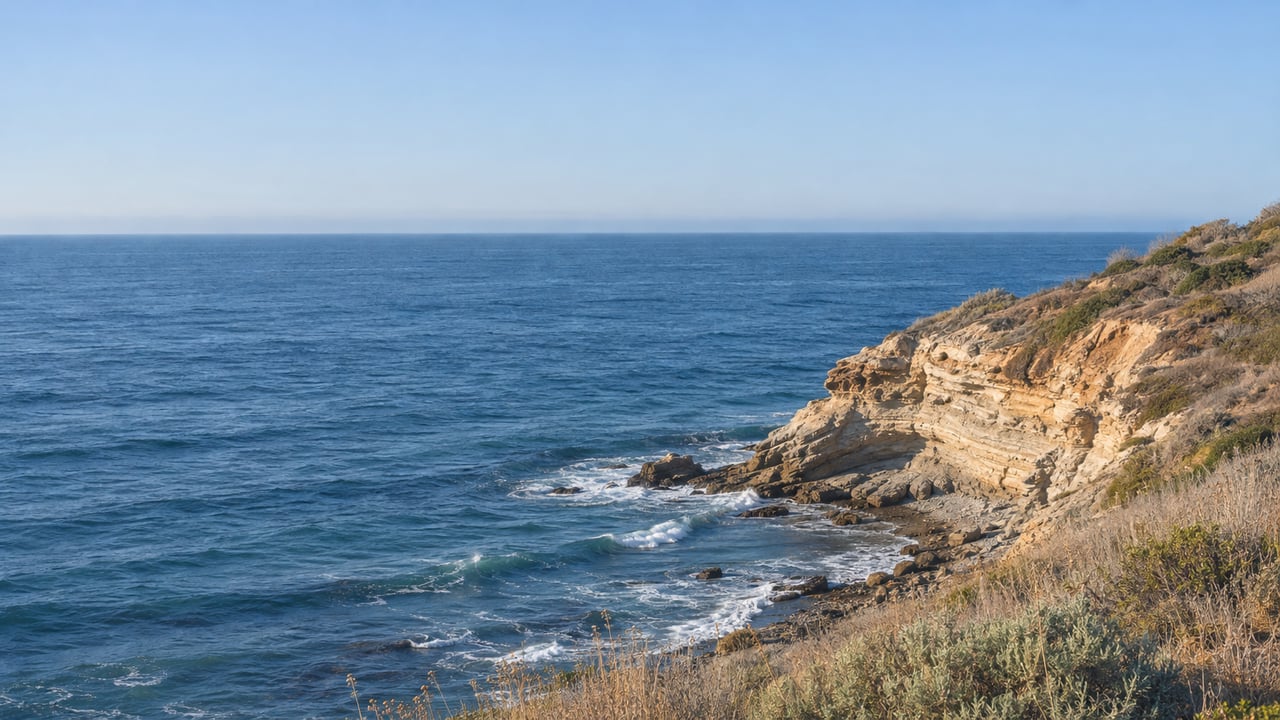
"When you think of the good old days, I could see 80, 90, 100 gray whales a day. 152 was our highest on one day. I think this year we had 30 on one day." Alisa Schulman-Janiger said that to Spectrum News this July, at the end of the 2025–26 migration season. She directs the American Cetacean Society Los Angeles Gray Whale Census and Behavior Project, which counts from the bluff at Point Vicente Interpretive Center in Rancho Palos Verdes.
The same month, NOAA Fisheries published a population estimate that pointed the other way. On Tuesday, December 1, the volunteers go back to the Point Vicente bluff, and their daily tallies this winter will be the closest check residents have on whether NOAA's higher number shows up off the Peninsula.
The estimate went up while the bluff count stayed low
NOAA's July 2026 technical memorandum put the eastern North Pacific gray whale population at 17,750 whales for the 2025–26 southbound migration. Its updated figure for 2024–25 was 12,890. The authors called the higher number "an encouraging finding." They gave a 95% confidence range of 15,930 to 20,530 whales for 2025–26. The NOAA report also lists its own caveats. Year-to-year estimates have been inconsistent, calf production is still low, and a jump of this size may be larger than the population could plausibly grow in one year. Changes in the survey, in how many whales observers detect, or in the migration itself could be part of the gap.
The estimate also depends on where it was made. NOAA's observers surveyed from central California between January 5 and February 13, 2026, and their number covers the whole population. The Point Vicente count records the whales that actually pass the Palos Verdes Peninsula, counted in daylight from December through May.
On that bluff, the 2025–26 season "slightly improved" on the one before but stayed low, according to the same Spectrum News interview. The season before that set the baseline. ACS/LA's 2024–25 census summary recorded 130 southbound gray whales and no southbound calves for the season that ran December 1, 2024 to May 25, 2025. The northbound count was 485 whales, 8 of them calves. The project called those southbound and northbound totals and calf counts record lows. Its volunteers also reported many skinny whales and more strandings, especially off Mexico.
NOAA's estimate grew by roughly 4,900 whales from 2024–25 to 2025–26. At Point Vicente, Schulman-Janiger recalled a 30-whale day last season, against the project's single-day record of 152.
How the count runs from the bluff
ACS/LA runs the census as a shore-based project at Point Vicente Interpretive Center. It runs every year from December 1 through late May, in daylight. Trained volunteer citizen scientists log each gray whale and its behavior, and they record the dolphins and other marine mammals that pass too.
The 2024–25 summary shows how much work that takes. That season 100 volunteers put in 8,767 effort hours, and observer teams covered 2,013 hours of watching over 173 days. Schulman-Janiger told Spectrum News she has run the project since 1984. The season that closed this spring was its 42nd, so the count that opens December 1 is the 43rd.
Few places have four decades of records like this. A long run of counts from one spot, done the same way each season, lets the volunteers compare a 30-whale day with the 80-to-100-whale days of earlier years. The Interpretive Center is also a City of Rancho Palos Verdes facility with grounds open to the public, so residents can watch from the same bluff the volunteers count from.
Where to watch on the Peninsula
Point Vicente Interpretive Center is the obvious first stop. The City of Rancho Palos Verdes lists the museum and gift shop as open daily from 10 a.m. to 5 p.m., with the grounds open from dawn to dusk. Its exhibits cover the Peninsula's natural and cultural history and put the most emphasis on the Pacific gray whale. The City's facility page lists parking, trails, picnic areas, restrooms and whale watching among the site's features. The grounds open before the museum does, so an early-morning visit works on a weekday too.
In Palos Verdes Estates, bluff-top trails with ocean views run along Paseo Del Mar. The City lists pedestrian beach access from the 300 block of Paseo Del Mar and includes Lunada Bay Plaza among its passive parks, according to Palos Verdes Estates' recreation page. The Paseo Del Mar bluffs are an easy walk for anyone who lives in the Estates and doesn't want to drive down the coast to Point Vicente.
Abalone Cove Shoreline Park sits farther down the coast at 5970 Palos Verdes Drive South. The City lists paid parking with lot hours of 9 a.m. to 4 p.m. The park itself is open from one hour before sunrise to one hour after sunset. On the City's Abalone Cove page, Abalone Cove Beach, Sacred Cove Beach and every beach-access trail in the reserve are listed as closed since July 9, 2024, so this is a place to watch from the upper park.
For families with younger kids, Cabrillo Marine Aquarium in San Pedro holds Whale Fiesta, a free, all-ages celebration of the gray whale migration. You can pair it with a morning at Point Vicente when out-of-town family visits.
What could change the count this winter
The volunteers and researchers interviewed by Spectrum News named one main threat. "The biggest threat is lack of food, and the lack of food is due to climate change," Schulman-Janiger said, adding that persistent warmer water is killing off the whales' prey. The same report cited Cascadia Research Collective in Washington. As of June, it had tracked at least 30 gray whale strandings in that state, close to an annual record.
Other boats off Southern California saw the same pattern. Island Packers, the concessionaire for Channel Islands National Park, told Spectrum News its gray whale sightings dropped by about 20% last season. Its crews also saw gray whales feeding along the Channel Islands, which may mean the whales were looking for food outside their usual Arctic feeding grounds.
As of July, researchers expected an El Niño to bring warmer ocean temperatures to California this winter. Schulman-Janiger told Spectrum News she worries the whales will be "traveling all over the place looking for alternative sources of food." That makes the 2026–27 season a hard one to predict from the bluff. More whales may pass if NOAA's higher estimate holds. Fewer may pass close to shore if hungry whales spread out.
NOAA's report puts the longer decline in context. It overlapped an unusual mortality event that NOAA dates from 2019 to 2023. Schulman-Janiger told Spectrum News she is still hopeful the population can rebound, as it has before. The 43rd Point Vicente census opens on Tuesday, December 1, and the Interpretive Center grounds are open from dawn to dusk.
Long winter mornings on the bluff are part of what makes life on the Palos Verdes Peninsula feel different from the rest of the South Bay, from the trails along Paseo Del Mar to the grounds at Point Vicente. If you're weighing a move to Rancho Palos Verdes or the Estates and want to know which streets are closest to these viewpoints, Rachel Ezra is happy to walk them with you, or to start with a complimentary valuation of the home you already enjoy them from.