"My doorbell literally rang at 5:20," one Fifth Street resident said, describing the year he bought fifteen large bags of candy and still ran low before 8 p.m. He'd stocked up so heavily that the cashier at Target asked where he lived so she could bring her own kids by.
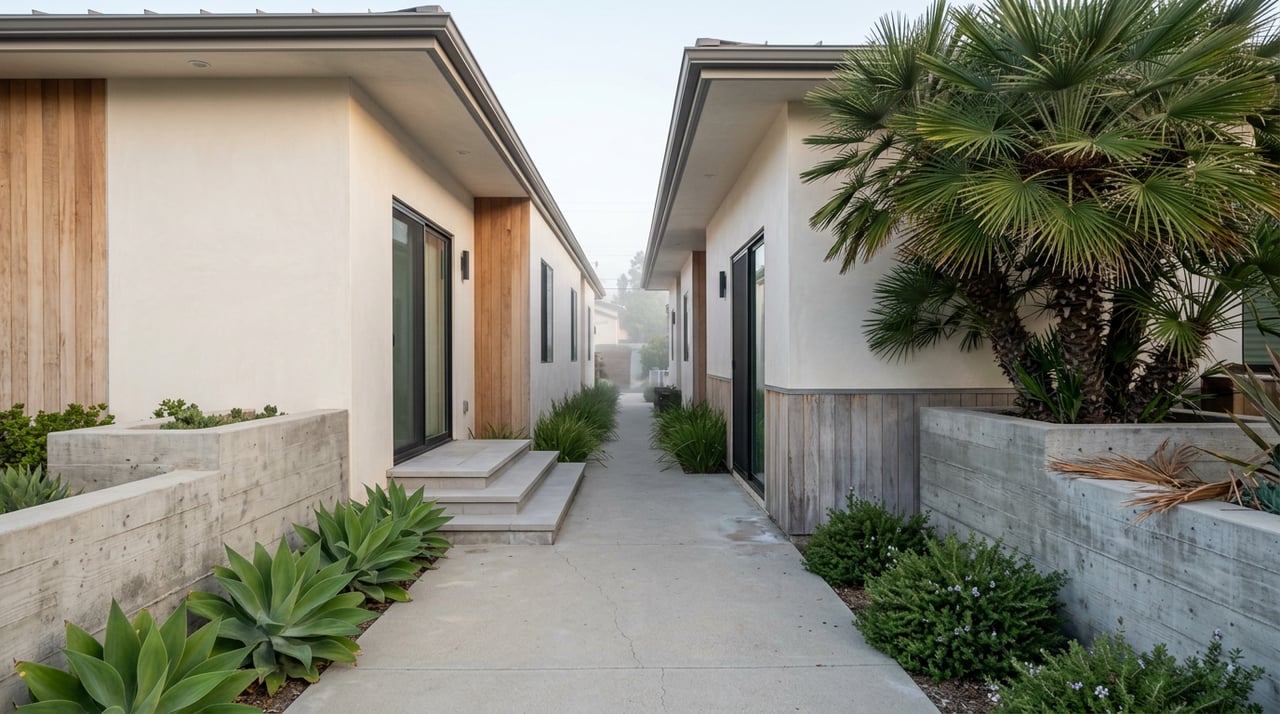
That's the kind of arithmetic Halloween forces on the Manhattan Beach walk streets, a stretch of car-free pedestrian corridors that has quietly become the busiest trick-or-treat destination in the South Bay. Nobody voted on this. No city ordinance designated these blocks as the place to go. It happened because a handful of houses decided, independently and over years, to compete with each other for the title of best-decorated porch, and the rest of the neighborhood inherited the consequences.
A Tradition Nobody Organized
The origin story lives on Fifth Street, where longtime residents Mark and Amy Howorth have spent years turning their front yard into a full production, at one point featuring a life-sized guillotine among the decorations. Mark has described the arms race in plain terms: over the years, everyone on the street decided to up the game, without ever formally discussing it, and now they all go large.
Amy Howorth, who has served three terms on the Manhattan Beach City Council and is on the ballot again this November, has talked about the tradition as something that outlasts her own household's need for it. Her kids are grown and out of the house, but she and Mark still look forward to Halloween every year, in part because grown adults now stop Mark on the street to tell him he scared the daylights out of them as kids.
That kind of multi-generational memory is unusual for a holiday that most neighborhoods treat as a single evening. On the walk streets, it functions more like an inherited obligation. Buy a house on one of these blocks and you're not just getting a car-free front yard, you're getting a standing invitation to compete with the neighbors every October.
Where the Crowd Actually Concentrates
Not every walk street sees this kind of traffic, and the geography matters more than people assume. The activity concentrates in the South End, where the walk streets are flat rather than sloped toward the beach. Local accounts put the core roughly between Third or Fourth Street and Eleventh, bounded by Crest Drive and Valley Drive. That flatness is the whole mechanism. Toddlers can cover ground without a parent bracing for a hill, strollers roll without effort, and because there's no vehicle traffic to manage, families let kids range further ahead than they might on a normal residential block.
Longtime hosts describe wildly different closing times depending on how their household handles the volume. One resident on these blocks says her family starts with neighborhood kids around 4:30 and doesn't wrap up until 8:30, or until the porch light goes dark. Another shuts things down at 8 sharp rather than risk another 250 kids showing up. A third keeps the early hours for locals only, then lets the wider stream of visitors flow through from 6 to 7:30. A fourth says school nights end the whole operation by 9.
That range says something the generic version of this story misses. There's no single walk streets experience. There's a block-by-block negotiation between how much candy a household is willing to buy and how late they're willing to stand on their porch, and every family arrives at a different answer.
Why This Saturday Changes the Math
Halloween falls on a Saturday in 2026. That single fact resets every one of those calculations.
The "school night" logic that pushes some hosts to shut the light off at 8 doesn't apply this year. There's no early bedtime to protect, no 7 a.m. bell to make. A weekend Halloween has historically meant a wider radius of visitors willing to drive in from outside the immediate blocks, since nobody needs to rush home for a Monday morning. If the Fifth Street resident who ran out of candy by 8 p.m. on a weeknight was fielding that kind of volume, a Saturday version of the same night, with no reason for families to turn in early, points toward a longer, busier evening than a typical midweek Halloween produces.
For a resident deciding how much candy to buy this year, that's the number that actually matters, not a vague sense that "it gets busy." It's the difference between planning for an evening that naturally tapers around a bedtime and planning for one that could run well past dark with no built-in stopping point.
The Same Weekend, Stacked
Halloween on the walk streets rarely happens in isolation. Past years have followed a fairly consistent pattern of events landing in the same window, even as exact dates shift year to year:
| When (typical pattern) | Event | Where |
|---|---|---|
| A few nights before Halloween | MBPD-hosted Trunk-or-Treat | Rotates, often a closed-off residential block |
| The weekend before Halloween | Halloween Golf Cart Parade | Starts at Pacific Elementary, winds through downtown |
| Halloween night | Creatures of Culture pet costume contest | Culture Brewing Co. on Manhattan Beach Boulevard |
| Halloween night | Walk streets trick-or-treating | South End walk streets, roughly Third/Fourth to Eleventh |
Culture Brewing's pet costume contest hit its fourth year in 2025, which puts it on track for a fifth in 2026. It's worth knowing about even if you don't own a dog, because it means the same night that empties candy bowls on the walk streets also pulls a costumed crowd toward the brewery a few blocks inland, adding foot traffic to an already busy stretch of town. Checking the current year's exact times before you commit to a plan is worth the two minutes it takes, since these are locally run events that can shift by a day or an hour from year to year.
If You're Hosting
The residents who've done this for years converge on a few practical habits. Buy more candy than feels reasonable. Fifteen large bags was one host's number on a normal weeknight, and that was before he ran out. Decide your cutoff time before the night starts, not in the moment, because once the porch light goes on, turning people away gets harder the later it gets. And know that the volume isn't limited to kids. Adults showing up with pillowcases to fill is common enough that at least one host has made peace with simply redirecting them rather than treating it as an insult.
If you're new to one of these blocks, there's no shame in starting small the first year and calibrating from there. Nobody expects a first-time host to match a guillotine.
If You'd Rather Skip It
Not every Manhattan Beach household wants their front door to become a candy distribution point for a few thousand strangers, and there's a lower-key alternative if that's not your evening. The city's Parks and Recreation Department has its 38th Annual Family Halloween Carnival scheduled for October 24, 2026, from 1 to 5 p.m. at Manhattan Heights Park, a free-to-attend, staffed event with carnival games, a costume contest and parade, and a haunted house, aimed at kids roughly two to fourteen. It's a controlled environment rather than an open-door one, and it lands on a weekend afternoon a week before Halloween itself, which makes it a reasonable option for families who want the holiday without the walk street crush at their own address.
The contrast is instructive. The walk streets tradition exists precisely because nobody is managing it. The carnival exists because the city decided some families would rather have Halloween handled for them. Both are genuinely Manhattan Beach. They just serve different appetites for chaos.
The Actual Takeaway
None of this is really about candy. It's about what happens when a stretch of pedestrian-only streets, built for foot traffic almost a century ago, becomes the default stage for a tradition nobody planned and nobody can opt out of once they've bought on the block. The walk streets don't have a homeowners association dictating decoration rules or an event permit governing crowd size. What they have is a decades-old, informal understanding among neighbors that whoever lives there now inherited from whoever lived there before, and a Saturday date this year that's likely to push that understanding further than usual.
If you're weighing whether your own block could handle a night like this, or you're simply curious what the rest of the year looks like once you're living here full time rather than visiting, Rachel Ezra knows this stretch of Manhattan Beach block by block, walk street by walk street. Request a Complimentary Home Valuation whenever you're ready to talk about what a specific address here is actually worth, Halloween traffic included.